Sunset Verify
we grade our own homework.
Every evening, Vesper publicly scores its own sunset prediction against your rating. The only weather app with the transparency to do that — in tabular numbers, with no spin.
How it works
three steps, every evening.
- 01
Predict
81tonightEach afternoon Vesper scores the coming sunset 0–100 using live atmospheric data — cloud altitude, humidity profile, particulate count.
- 02
Capture
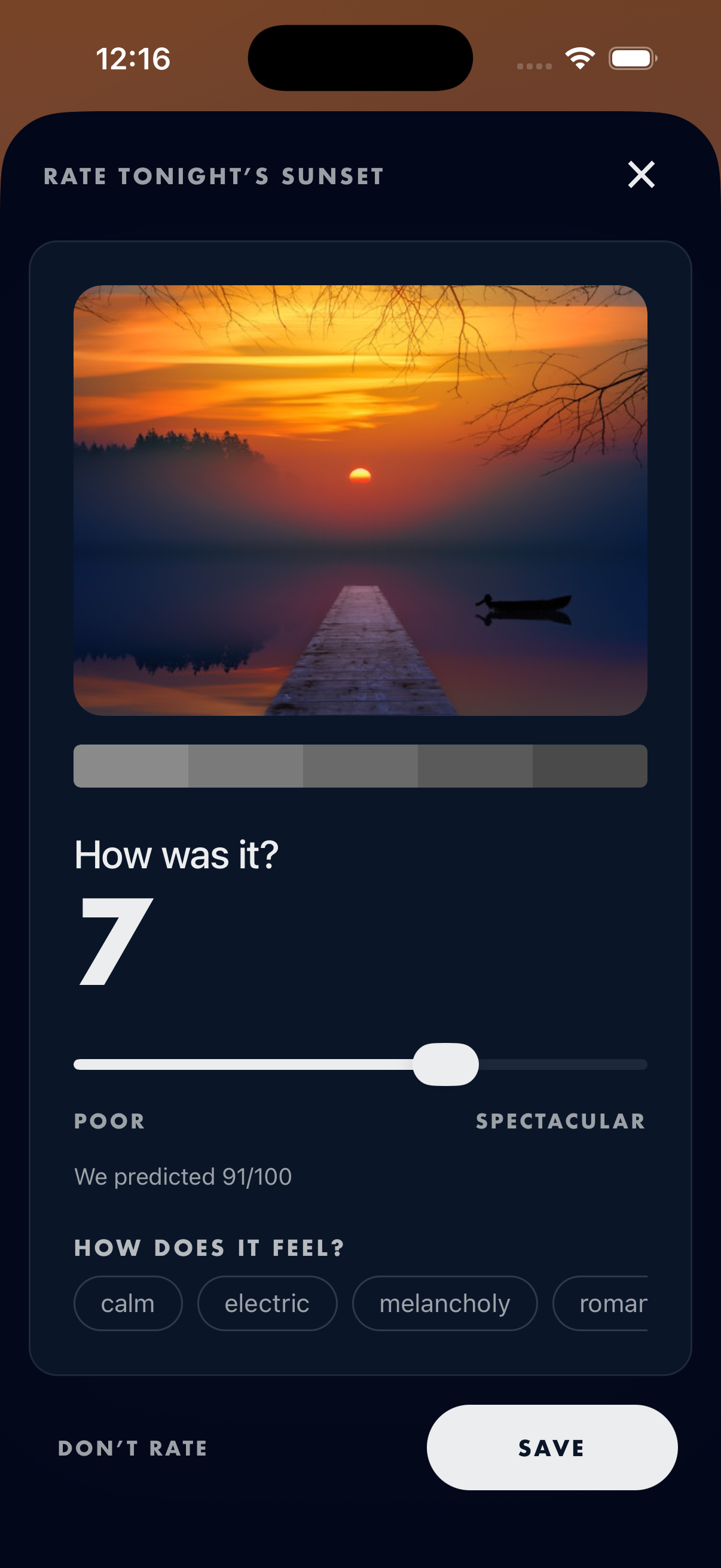
9/ 10After sunset, rate the sky with a tap or snap a photo. The photo stays on your device — no upload, no cloud, no surveillance.
- 03
Grade
91% matchVesper compares its prediction to your rating and publishes the accuracy. No hiding the misses, no spinning the wins.
Your sunset journal
every sky you’ve verified.
Every prediction, every rating, every photo — collected in a scrollable timeline. Watch your accuracy track record build over weeks and months. Photos never leave your device.
Live Activity
the countdown is on your lock screen.
As golden hour approaches, a Live Activity appears on your lock screen and Dynamic Island. The sunset score, the time remaining, and a gentle nudge to look up.
Transparency
why nobody else does this.
Risk
Publishing your accuracy means admitting when you are wrong. Most weather apps would rather not. The math gets uncomfortable in writing. The miss rate gets memorable in a chart.
Effort
Verification requires a scoring algorithm, a user-input loop, atmospheric calibration, and a publishable comparison. None of those are free. Most apps choose not to build them.
Philosophy
Most weather apps are advertising platforms with a forecast attached. Vesper is an editorial product with a forecast at its center. The incentive to be honest is built into the business model, not bolted onto the UI.
How does Sunset Verify work?
Sunset Verify predicts sunset quality on a zero to one hundred scale each afternoon from live atmospheric data including cloud cover, cloud altitude, humidity, and visibility. After sunset you can rate the sky or snap a photo. Vesper compares its prediction to your rating and publishes the accuracy score, building a transparent track record over time.
Frequently Asked Questions
What data does Sunset Verify use?
Sunset Verify uses live atmospheric data including cloud cover, cloud altitude, humidity, and visibility to generate a sunset quality prediction on a 0-100 scale. The algorithm weights cloud coverage on a bell curve peaking near 50% — the sweet spot where golden-hour light catches the most color.
Do I have to take a photo to verify?
No. You can verify by tapping a star rating. Photos are optional and stored only on your device, never uploaded to Vesper servers.
How accurate are the sunset predictions?
Accuracy varies by location and conditions. Vesper publishes its rolling accuracy score transparently so you can see exactly how well it performs over time.
Can I see past sunset predictions?
Yes. Your personal sunset journal stores every prediction, your rating, and the accuracy match in a timeline view you can scroll through.
Does Sunset Verify work everywhere?
Sunset Verify works for any location where Vesper has weather data coverage, which includes essentially every populated area worldwide.
What counts as a good sunset score?
Scores above 75 usually indicate a sunset worth stopping for — meaningful color in the sky and enough atmospheric texture to make the light do something. Scores below 40 mean flat gray or overcast. The sweet spot for peak color is typically around cloud cover in the 30 to 60 percent range.
What happens when Vesper is wrong about a sunset?
Nothing is hidden. Wrong predictions are logged publicly in the accuracy track record right alongside the correct ones. Over weeks and months, the rolling accuracy score shows exactly how reliable Vesper is in your specific city — which is the whole point of the feature.
Does Sunset Verify use my photos for anything?
No. Photos taken through Sunset Verify are stored only in your device Photos library and never uploaded, never analyzed on a server, and never used to train models. The rating you provide is what Vesper compares against its prediction.
What is the sunset score based on?
The score weights cloud coverage (bell curve peaking near 50 percent), cloud altitude (high wispy clouds score better than low decks), humidity (moisture amplifies color), and visibility. Clean air produces crisper color, while moderate high cirrus catches golden-hour light best.